Fermentation / Drying / Decaffeination
Coffee processing
Processing transforms a fresh cherry into a stable green bean. It is not a secondary detail: it decides cleanliness, sweetness, body, acidity, aroma, shelf life and whether a coffee keeps flavor after caffeine is removed.
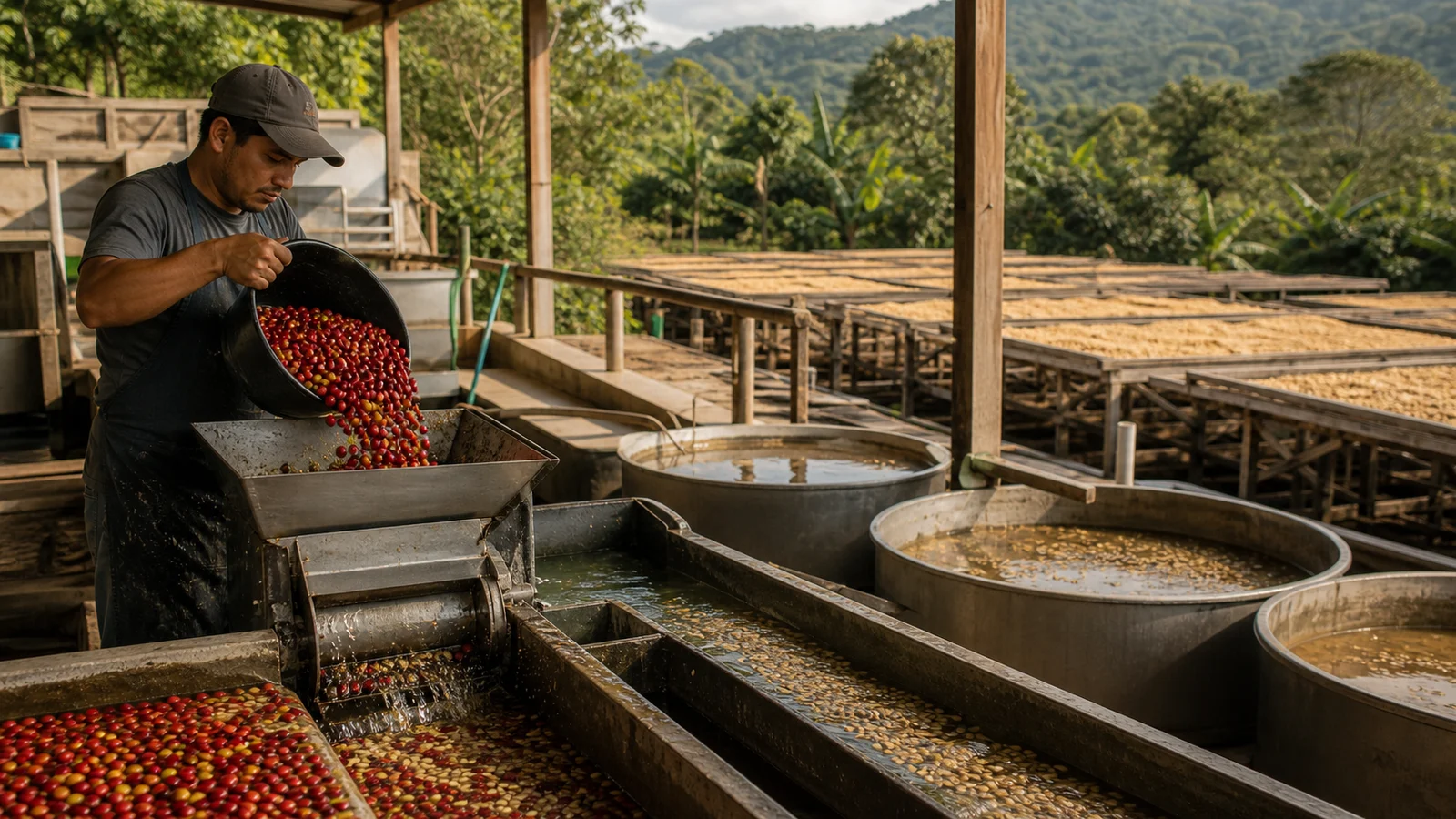
Transforms mucilage, sugars and aromatic precursors through microorganisms and enzymes.
Gradually stops biological activity and stabilizes the bean for storage.
Removes caffeine from green coffee before roasting while trying to preserve most flavor.
The cup depends on variety, ripeness, process, drying, storage, roasting and brewing.
Scientific basis
What happens during fermentation
Coffee fermentation happens when yeasts, bacteria and enzymes act on sugars, pectins and other compounds in mucilage and pulp. Its historical practical role was to help remove mucilage in washed coffee. Today it is also used to modulate aroma, acidity, texture and complexity.
Fermentation is not a single recipe. It changes if the coffee is whole or depulped, if oxygen is present, if there is water, if microorganisms are inoculated, if temperature climbs too high or if the lot contains unevenly ripe cherries. That is why two producers can say anaerobic and obtain completely different results.
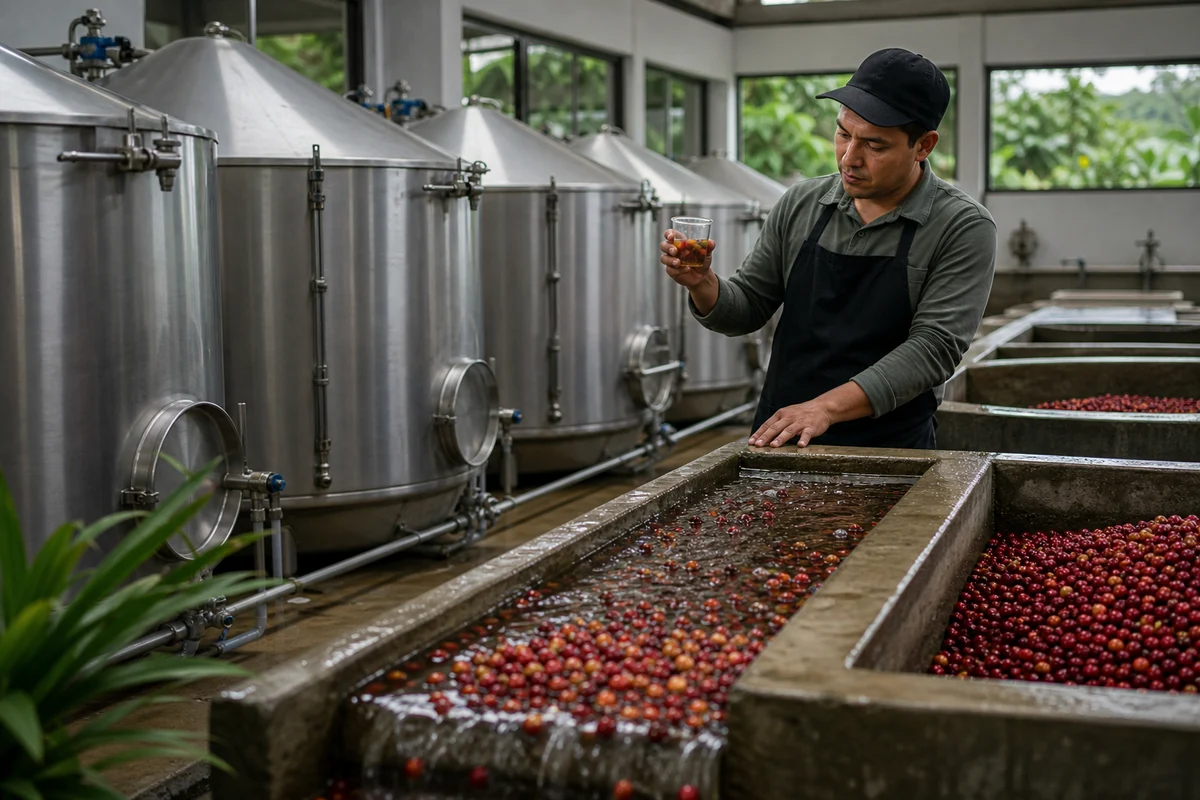
Post-harvest path
From fruit to green bean
Ripeness defines sugars, acids and aromatic potential. No process fixes an unripe cherry.
Floatation and selection remove defective, insect-damaged or overly dry fruit.
Microorganisms break down mucilage and transform compounds. Part of the aromatic profile is decided here.
Depending on the method, mucilage is removed, partly kept or the whole cherry is dried.
Moisture must drop slowly and evenly to avoid mold, flat flavors or fast aging.
Coffee stabilizes before parchment or husk is removed and export preparation begins.
Fermentation types
Main methods and how they change the cup
Commercial names can vary by country, but these categories explain most of what you will find in specialty coffee. The important thing is reading the method together with variety, farm, altitude and drying.
Classic washed
Context: Depulped coffee with mucilage attached, fermented in tanks with water or dry before washing.
Variables: Time, temperature, mucilage thickness, pH, microbial load and tank cleanliness.
In the cup: Cleanliness, defined acidity and more terroir clarity; mistakes bring sour, phenolic or dirty notes.
Natural
Context: The whole cherry ferments and dries with skin, pulp and mucilage around the seed.
Variables: Bed thickness, movement, shade, humidity, even ripeness and drying speed.
In the cup: More fruit, body and perceived sweetness; higher risk of over-fermentation if drying is uneven.
Honey or pulped natural
Context: The skin is removed, but part of the mucilage remains during drying.
Variables: Amount of mucilage, commercial honey color, ventilation and drying time.
In the cup: Middle ground: more sweetness and body than washed, with more clarity than many naturals.
Anaerobic
Context: Fermentation in closed vessels with little oxygen and control over pressure, temperature or time.
Variables: Seal quality, CO2 concentration, temperature, duration, inoculation and hygiene.
In the cup: Can increase fruit, spice, liqueur and intense aromatics; poor control creates artificial or solvent notes.
Carbonic maceration
Context: Wine-inspired: whole cherries in a CO2-rich environment, favoring intracellular fermentation.
Variables: Whole cherry, CO2, low or moderate temperature, extended duration and pressure.
In the cup: Winey aromas, red fruit, complexity and texture; needs fine control so it does not dominate coffee identity.
Cultured fermentation
Context: Selected yeasts, lactic bacteria or other cultures are used to steer fermentation.
Variables: Strains, dose, temperature, substrate, competition with local microbiota and traceability.
In the cup: More repeatability and designed profiles; the challenge is keeping balance and transparency.
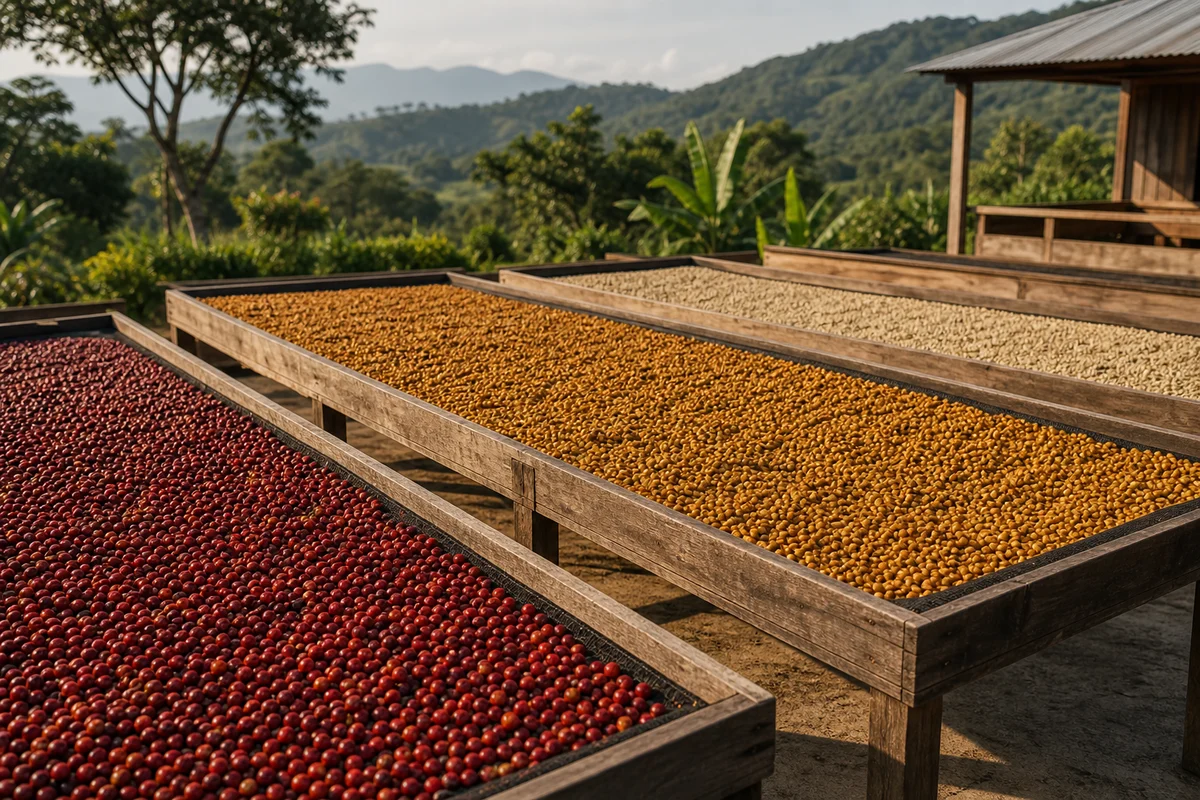
Natural, honey and washed
It is not all fermentation: what dries also matters
In a washed process, the bean dries mainly as clean parchment. In honey, it dries with partial or abundant mucilage. In natural, the seed dries inside the whole cherry. That difference changes how much pulp participates, how much sugar remains close to the seed and how many days of biological activity the producer must control.
The best process is the one with intention and control. A washed coffee can be extraordinarily expressive; a natural can be clean and elegant; a honey can balance both worlds. Defects appear when complexity is confused with disordered fermentation.
Coffee without caffeine
How coffee is decaffeinated
Decaffeination happens before roasting, with green coffee. The difficulty is removing caffeine without taking away too many compounds that build aroma, sweetness and body. That is why all methods combine three ideas: swelling or moistening the bean to move caffeine, using an extraction medium and then drying the coffee into a stable state.
Good decaf does not depend only on the method. It depends on base coffee, freshness, industrial control, transport and roasting. A mediocre coffee decaffeinated carefully will still be mediocre; a good lot, processed with care, can keep much of its identity.
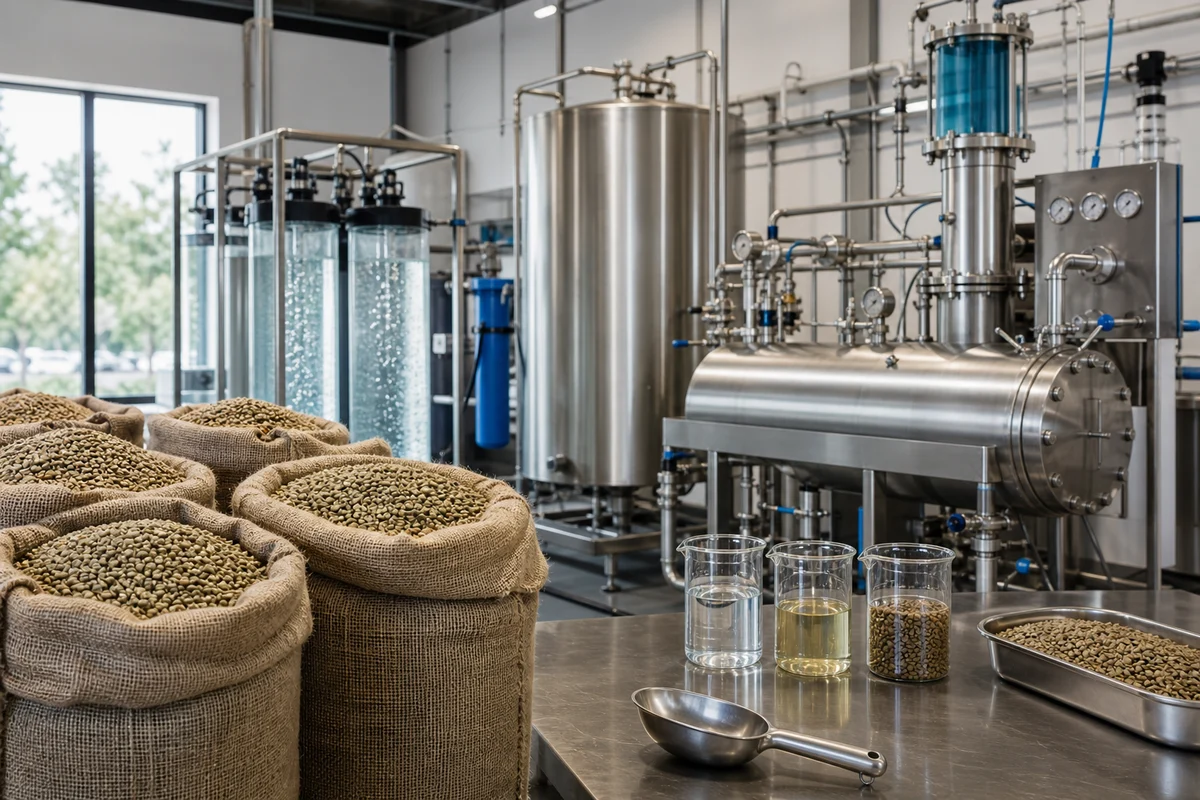
Decaffeination methods
Water, solvents and CO2
Water process
Principle: Uses water and green coffee extract saturated with soluble compounds to remove caffeine by diffusion.
Strengths: No direct organic solvents; often communicates a clean and traceable image.
Trade-off: Can soften the cup if the base coffee or extraction control is not good.
Ethyl acetate
Principle: A solvent that binds to caffeine. It can come from natural sources such as sugarcane, though purity and control matter most.
Strengths: Common in Latin American coffees; can preserve sweetness and body when handled carefully.
Trade-off: The word solvent creates confusion, even though the final coffee is steamed and dried to remove residues.
Methylene chloride
Principle: A caffeine-selective solvent used in direct or indirect processes under strict regulatory limits.
Strengths: Efficient and capable of preserving many aromatic compounds because of its selectivity.
Trade-off: Faces more public resistance; requires industrial control and residual-limit compliance.
Supercritical CO2
Principle: Carbon dioxide under high pressure acts as a selective caffeine extraction fluid.
Strengths: Very selective, with no residual organic solvents, suited to precise industrial operations.
Trade-off: Requires expensive equipment and enough scale.
Safety and flavor
What decaffeinated means in practice
No method should leave coffee tasting chemical. In solvent processes, coffee is steamed and dried to remove residues, and markets regulate permitted limits. Water and CO2 processes are often easier to communicate, but they still require control so important solubles are not lost.
To choose a decaf, look at origin, method, roast date and profile. If the roaster communicates the method and base coffee clearly, there is usually more care behind the product.
Common myths
Frequent mistakes when talking about processing
Decaf does not mean zero caffeine
It usually removes the vast majority, but small amounts can remain. The exact definition depends on the market.
Process does not create quality from nothing
It can reveal, organize or transform potential, but poor cherries still limit the result.
Anaerobic is not automatically better
It is a tool. Without control it can cover origin, variety and defects with excessive aromas.
Natural does not mean careless
A quality natural requires sorting, thin layers, movement, humidity control and patience.
Reference sources
This page summarizes concepts used in quality, post-harvest processing and industrial decaffeination.