Arabica / Family tree / Cup
Arabica varietals
A varietal is not just a beautiful name on a bag. It is a story of origin, genetics, plant architecture, resistance, productivity and sensory potential. Understanding the arabica tree helps you read a label and understand why two coffees can be radically different even when both say Coffea arabica.
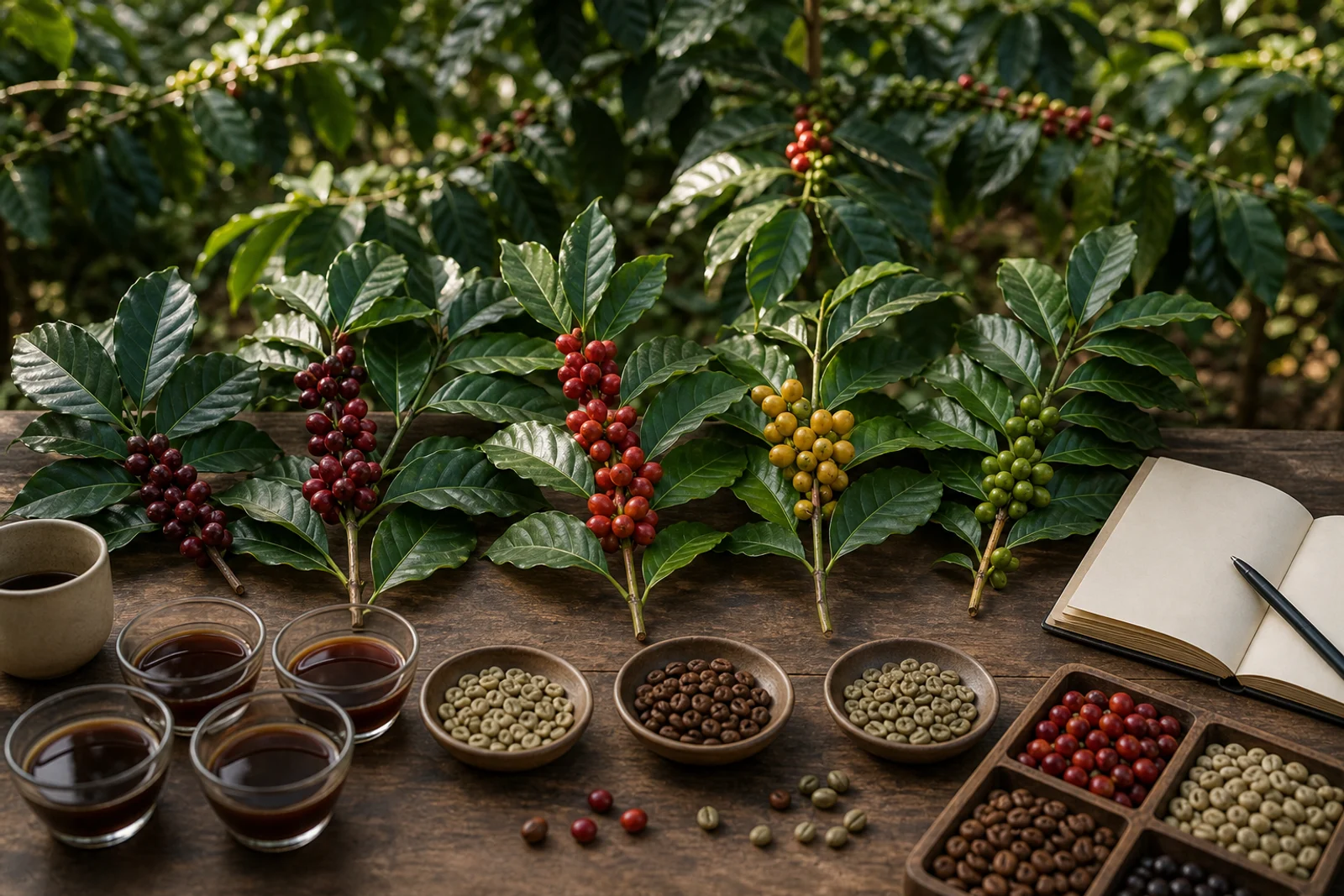
Allotetraploid, with a narrow genetic base outside Ethiopia but enormous sensory impact.
Most historical global coffee derives from these two domesticated trunks.
Gesha, SL28, SL34 and Rume Sudan show arabica diversity does not end in Latin America.
Catimor, Sarchimor and F1 hybrids connect quality with agronomic survival.
Mental map
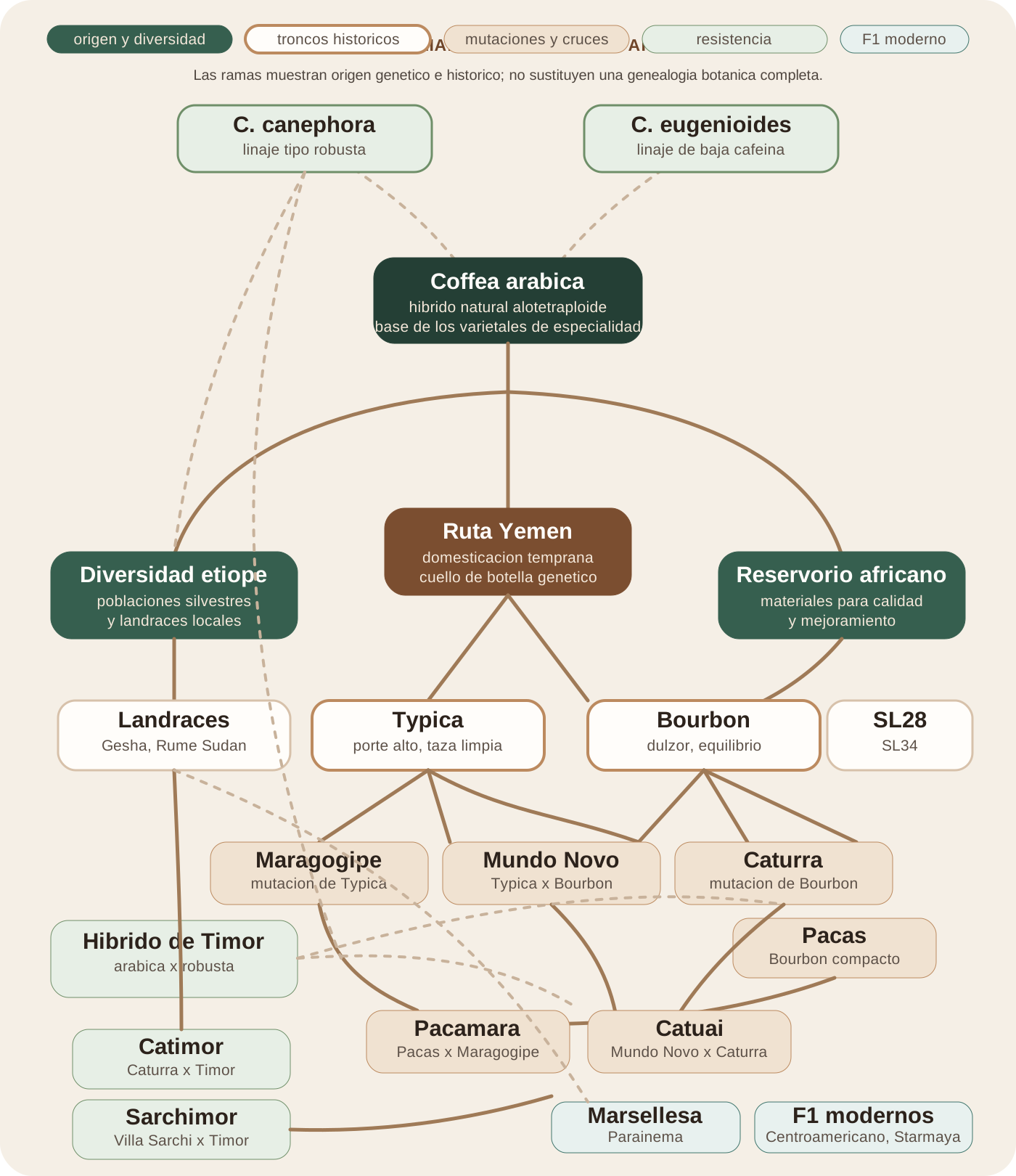
A simplified arabica tree
The real genealogy is more complex than a diagram: local selections, undocumented crosses, spontaneous mutations and country-specific names all exist. Even so, this approximation is useful: first wild diversity, then the Yemen-Typica-Bourbon bottleneck, then agronomic mutations and crosses, and finally resistance introgression and modern F1s.
Wild arabica
The original genetic reserve: diverse populations adapted to shade, altitude and forest microclimates.
- Ethiopian landraces
- Gesha
- Rume Sudan
Yemen route
A genetic bottleneck: few plants left for Yemen and then the world, creating the Typica and Bourbon bases.
- Typica
- Bourbon
Typica
Tall plant, relatively low productivity, good quality and high rust susceptibility; a historic base of many farms.
- Maragogipe
- Kent
- Mundo Novo
Bourbon
More productive than Typica, sweet and balanced cup, still disease vulnerable; source of many compact mutations.
- Caturra
- Villa Sarchi
- Pacas
- SL28
- SL34
Crosses and mutations
Modern agronomy crosses plants for stature, productivity, local adaptation and sensory quality.
- Catuai
- Pacamara
- Mundo Novo
Introgression
Resistance genes enter arabica to face rust and other pressures. Quality depends on each selection.
- Catimor
- Sarchimor
- Marsellesa
- Parainema
F1 hybrids
Controlled crosses use hybrid vigor for productivity, quality and resilience, although seed requires specialized management.
- Centroamericano H1
- Milenio H10
- Starmaya
How to read the tree
Lineage is not destiny, but it orients
A variety name does not guarantee flavor. Final flavor depends on altitude, soil, shade, nutrition, ripeness, harvest, process, drying, storage, roasting and brewing. But genetics defines limits and tendencies: plant size, planting density, disease susceptibility, ripening, aromatic potential and production stability.
Think in layers. Typica and Bourbon explain the historic base. Mutations such as Caturra or Pacas explain plant stature. Crosses such as Catuai or Pacamara explain agronomic and sensory decisions. Introgressions such as Catimor and Sarchimor explain resistance. F1s such as Centroamericano explain current breeding.
Arabica exists as diverse wild populations. Real diversity is not one famous variety, but many forest genotypes.
The drink becomes crop and trade. The departure of few plants creates a narrow genetic base for Typica and Bourbon.
Typica travels through botanical gardens and colonial routes; Bourbon multiplies from Bourbon Island toward Africa and the Americas.
Productivity, short stature and resistance become priorities. Caturra, Catuai, Catimor, Sarchimor and regional selections appear.
Gesha, SL28, Pacamara and Ethiopian landraces stand out for sensory profile while climate forces resistance to be valued.
F1s and new selections combine quality with resilience. The question is not only which tastes best, but which can sustain quality in a changing climate.
Varietal cards
Main characteristics
These cards summarize the most useful traits for reading a coffee label. Cup describes tendencies, not absolute promises; plant summarizes architecture and agronomy; risk shows why flavor is not the only decision.
Typica
- Cup
- Clean, sweet, gentle and delicate when well grown.
- Plant
- Tall plant, long internodes and low productivity compared with modern varieties.
- Risk
- Very susceptible to rust and disease.
One of the historic columns of cultivated arabica.
Bourbon
- Cup
- High sweetness, medium body, round acidity and classic balance.
- Plant
- Tall plant, more productive than Typica, with red, yellow or pink cherry variants.
- Risk
- Vulnerable to rust and demanding in nutrition and pruning.
The base of many Latin American mutations and crosses.
Caturra
- Cup
- Sweet and clear; often less complex than old Bourbon.
- Plant
- Short stature allows denser planting and easier harvest.
- Risk
- Susceptible to rust; high productivity demands fertility.
A key agronomic change without abandoning arabica quality.
Villa Sarchi
- Cup
- Good sweetness, lively acidity and clean high-altitude profile.
- Plant
- Compact plant adapted to windy highland areas.
- Risk
- Requires sanitary management.
Important in Costa Rica and as a modern-hybrid parent.
Pacas
- Cup
- Sweet, balanced and transparent when cultivation and process support it.
- Plant
- Short, productive and practical for dense farms.
- Risk
- Main advantage is architecture, not resistance.
Influential in Central America and parent of Pacamara.
Maragogipe
- Cup
- Soft, floral and elegant; not always intense.
- Plant
- Large bean and leaf, tall plant, generally low productivity.
- Risk
- Vulnerable and less profitable for volume.
Shows how mutation can strongly alter morphology.
Pacamara
- Cup
- Complex, with marked body, fruit, spice and expressive acidity.
- Plant
- Large bean, variable vigor, needs selection for stability.
- Risk
- Can be irregular and sensitive.
A cross oriented to cup and regional identity.
Mundo Novo
- Cup
- Sweet, chocolate, nut and good body; useful for espresso and blends.
- Plant
- Tall, vigorous, productive and adapted to Brazilian systems.
- Risk
- Needs pruning because of height.
A natural bridge between the two historic trunks.
Catuai
- Cup
- Sweet, accessible and versatile; quality depends on altitude and process.
- Plant
- Short, productive and good for intensive management.
- Risk
- Susceptible to rust.
One of Latin America’s most planted varieties.
Gesha
- Cup
- Floral, jasmine, bergamot, citrus and silky texture.
- Plant
- Tall plant, elongated leaves and moderate to low productivity.
- Risk
- Does not express quality everywhere and is costly to manage.
Changed specialty coffee by showing perfume-like profiles.
SL28
- Cup
- Intense acidity, red or black fruit, deep sweetness and high complexity.
- Plant
- Tall plant with useful drought adaptation in some contexts.
- Risk
- Susceptible to rust and CBD.
A sensory reference for Kenya.
SL34
- Cup
- Powerful profile, marked acidity, body and fruit.
- Plant
- Tall plant adapted to specific altitude and rainfall patterns.
- Risk
- Susceptible to important diseases.
Complements SL28 in the African quality tree.
Rume Sudan
- Cup
- Can add complexity and quality.
- Plant
- Valuable genetic material for diversity and potential resistance.
- Risk
- Low productivity or limited adaptation in some systems.
Important as a parent in modern breeding.
Catimor
- Cup
- Variable: simple in old selections or very correct in well-selected materials.
- Plant
- Short, productive and carrying rust-resistance genes from the Timor hybrid.
- Risk
- Quality can vary and resistance can break.
Represents the sanitary shift of the 20th century.
Sarchimor
- Cup
- Can offer sweetness and cleanliness with fine selection.
- Plant
- Compact, productive and oriented to rust resistance.
- Risk
- Needs local selection and does not guarantee quality alone.
Base of modern varieties such as Marsellesa and Parainema.
Marsellesa
- Cup
- Sweet, chocolate and moderate fruit with commercial and specialty potential.
- Plant
- High productivity, compact stature and rust resistance in many contexts.
- Risk
- Cup expression depends on altitude, nutrition and process.
A practical example of resistance with competitive cup.
Parainema
- Cup
- Can show tropical fruit, spices and strong structure.
- Plant
- Compact, vigorous, rust-resistant and regionally adapted.
- Risk
- Not every farm gets the same profile.
Shows resistant materials can have strong sensory identity.
Centroamericano H1
- Cup
- High quality potential, sweetness, fruit and clarity.
- Plant
- Hybrid vigor, high productivity and improved resistance/tolerance.
- Risk
- F1 seed does not reproduce faithfully by conventional seed.
Symbolizes modern breeding: African diversity, resistance and quality together.
Starmaya
- Cup
- Good quality potential and balanced profile.
- Plant
- Productive, with F1 advantages and more scalable propagation.
- Risk
- Must be evaluated by region and management.
Important because it makes modern hybrids more accessible.
Synthesis
What to look for when buying coffee by varietal
If you see Typica, Bourbon, Gesha, SL28 or Pacamara, expect the producer to communicate cup potential and botanical identity. If you see Caturra, Catuai or Mundo Novo, think farm varieties widely used for the balance between management, productivity and quality. If you see Catimor, Sarchimor, Marsellesa, Parainema or an F1, also ask about resistance, climate and productive sustainability.
The best reading combines three questions: where the plant comes from, what agronomic problem it solves and what sensory profile it can express in that specific place.
Reference sources
The lineage structure and cards are based on technical catalogs and current botanical literature.